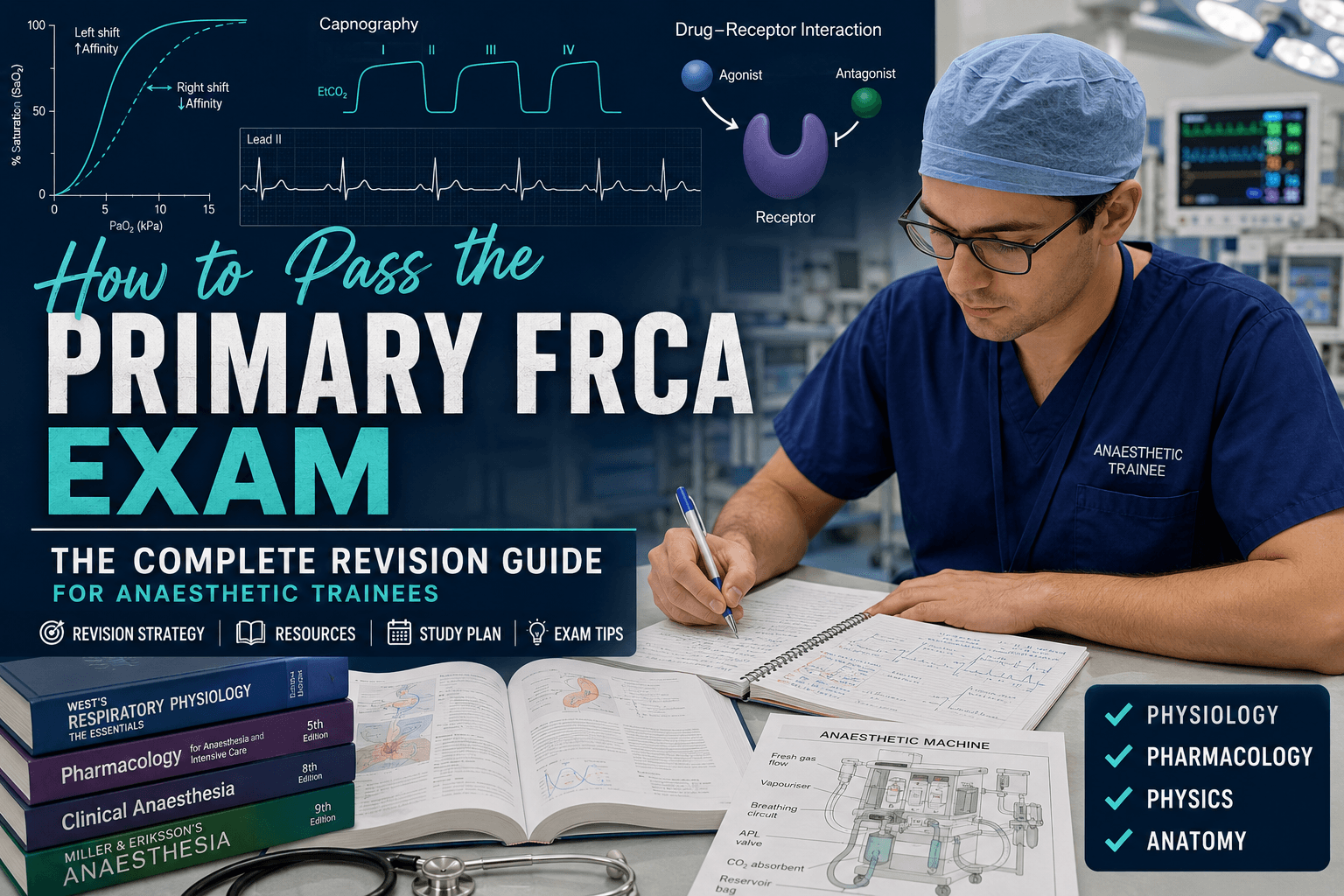
The Primary FRCA examination is often described as one of the most challenging milestones in anaesthetic training. Speak to any consultant anaesthetist and they will almost certainly remember their own experience of preparing for it: evenings spent revising respiratory physiology, countless pharmacology flashcards, and the persistent feeling that there was always another topic left to learn. While the examination has a formidable reputation, it is important to remember that it is not designed to trick candidates or catch them out. Rather, it aims to ensure that future anaesthetists possess the scientific knowledge required to practise safely and effectively.
Many trainees begin their preparation believing that success depends largely on intelligence or having an exceptional memory. In reality, candidates who perform well tend to share a different characteristic: they approach the examination systematically. The Primary FRCA rewards understanding, consistency and effective revision techniques far more than last-minute cramming or memorisation of isolated facts.
One of the most important things to understand is that the Primary FRCA is fundamentally a basic sciences examination. Although it is directly relevant to clinical practice, it is not primarily testing whether you can manage a difficult airway or conduct an anaesthetic list independently. Instead, it examines the scientific principles that underpin every decision made in anaesthetic practice. This distinction is crucial because many trainees initially attempt to revise using only their clinical experience. While practical exposure undoubtedly helps, it is rarely sufficient on its own.
For example, most anaesthetic trainees administer propofol on a daily basis. However, the examination is not simply interested in whether you know that propofol induces anaesthesia. Candidates are expected to understand its pharmacokinetics, pharmacodynamics, metabolism, distribution, context-sensitive half-time and physiological effects. Similarly, using a ventilator every day does not necessarily mean that a trainee can confidently explain compliance curves, resistance, dead space ventilation or the principles underlying gas exchange.
Among all the subjects within the syllabus, physiology consistently emerges as the area that contributes most heavily to examination success. Respiratory physiology in particular forms the backbone of a large proportion of FRCA questions. Concepts such as ventilation-perfusion matching, oxygen transport, carbon dioxide carriage, pulmonary blood flow and acid-base balance appear repeatedly throughout the examination. Candidates who develop a strong understanding of these topics often find that many other areas of the syllabus become easier to understand.
Cardiovascular physiology is equally important. Understanding the determinants of cardiac output, the factors influencing venous return and the mechanisms controlling blood pressure provides a framework that helps explain the actions of many commonly used anaesthetic drugs. Rather than memorising individual facts, successful candidates learn to connect concepts together. Once these connections begin to form, revision becomes more efficient and the subject matter feels considerably less overwhelming.
Pharmacology represents another major component of the examination and is often regarded as one of the most enjoyable subjects to study. However, it is also an area where many candidates make avoidable mistakes. A common approach is to create extensive lists of drug doses, side effects and contraindications. Whilst factual knowledge is necessary, the examination is generally more interested in underlying principles than rote learning. Understanding why propofol causes hypotension is far more valuable than simply remembering that it does. Likewise, appreciating the pharmacological differences between fentanyl and remifentanil provides greater examination value than memorising potency figures alone.
A solid grasp of pharmacokinetics and pharmacodynamics forms the foundation of the entire pharmacology syllabus. Candidates should feel comfortable discussing concepts such as volume of distribution, clearance, elimination half-life, receptor interactions and concentration-response relationships. These principles recur throughout the examination and often form the basis of viva discussions. Once these fundamentals are mastered, learning individual drugs becomes considerably easier.
Physics is often the subject that generates the greatest anxiety among trainees. Many candidates have not studied physics formally since secondary school and approach the topic with understandable apprehension. Fortunately, the level of mathematics required is relatively modest. The challenge lies not in performing complex calculations but in understanding how physical principles apply to anaesthetic practice. Gas laws, pressure relationships, flow dynamics and electrical concepts underpin much of the equipment used in everyday anaesthesia. Once candidates recognise the practical relevance of these topics, physics often becomes one of the more predictable and rewarding areas of the syllabus.
The anatomy examined in the Primary FRCA differs somewhat from the anatomy encountered during undergraduate training. Rather than focusing on exhaustive detail, the examination concentrates on anatomy that is directly relevant to anaesthetic practice. Airway anatomy, the vertebral column, the epidural space and the major peripheral nerve plexuses appear frequently. Regional anaesthesia has become increasingly important within modern anaesthetic practice, and candidates are expected to demonstrate a detailed understanding of the anatomy underlying common nerve blocks.
One of the questions most frequently asked by trainees concerns the best resources for preparation. There is no universally perfect revision package, and each candidate will ultimately develop their own preferences. Nevertheless, certain resources consistently appear among successful candidates. Question banks have become an essential component of modern FRCA preparation, providing exposure to examination-style questions and helping identify areas of weakness. However, question banks should be viewed as diagnostic tools rather than primary learning resources. They are most effective when used alongside comprehensive reading and regular revision of core concepts.
Textbooks remain important despite the increasing popularity of online learning platforms. A small number of carefully selected resources is usually preferable to accumulating an extensive library that never gets fully utilised. Many successful candidates rely on a combination of physiology texts, pharmacology references and concise revision notes throughout their preparation. The key is consistency rather than constantly searching for new materials.
Perhaps the most important advice for any trainee preparing for the Primary FRCA is to recognise that the examination is a marathon rather than a sprint. Most successful candidates devote several months to structured preparation, gradually building their knowledge and confidence over time. There will inevitably be moments when progress feels slow and the syllabus appears overwhelming. These feelings are entirely normal and are shared by almost everyone who sits the examination.
Ultimately, the Primary FRCA is not simply an academic hurdle. The knowledge acquired during preparation forms the scientific foundation of a career in anaesthesia. Long after the examination has been passed, concepts learned during revision continue to influence clinical decision-making in operating theatres, critical care units and recovery areas throughout the country. Approached in the right way, preparation for the Primary FRCA becomes far more than examination study. It becomes an opportunity to develop a deeper understanding of the specialty itself.
