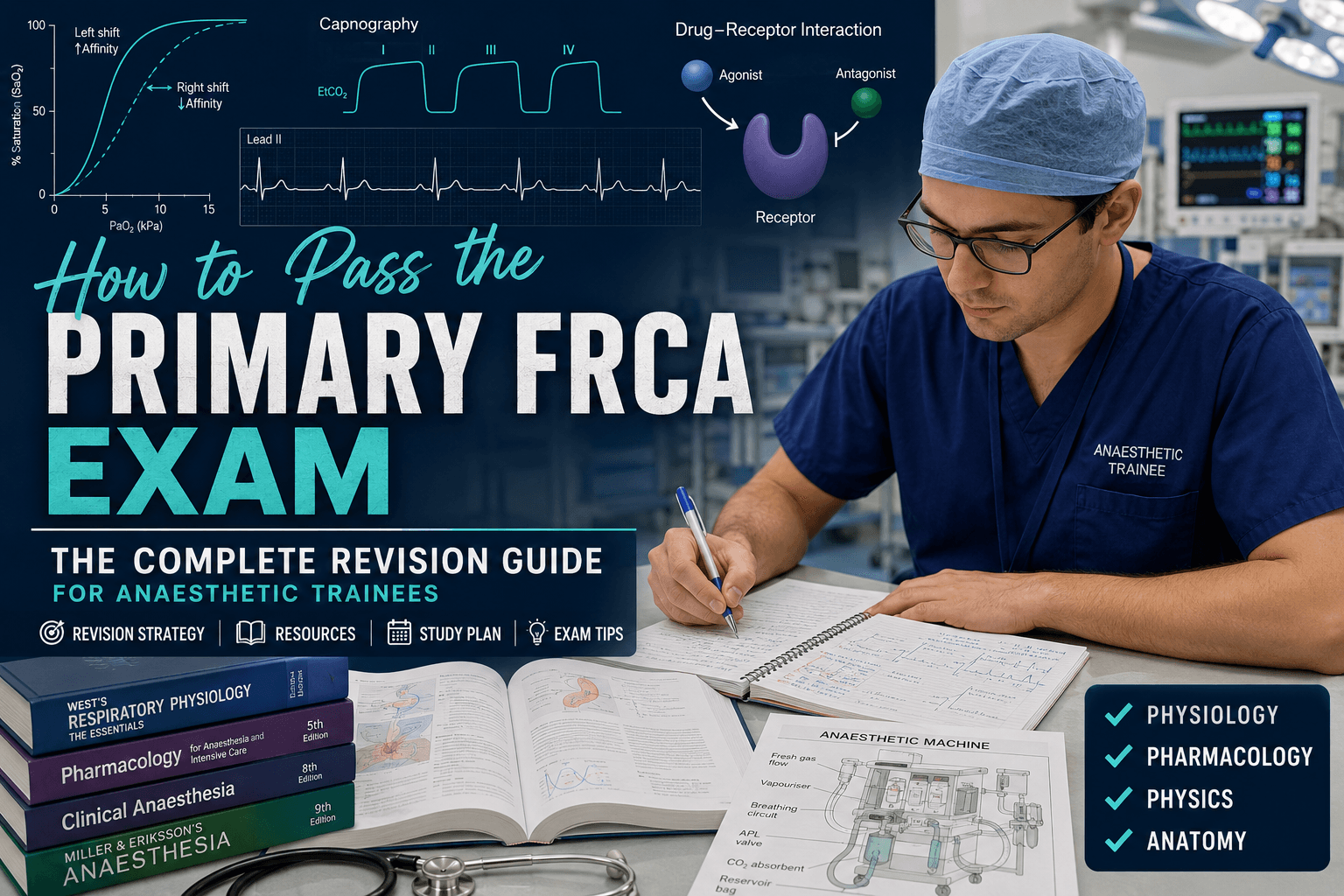
FRCA 2027: The New Exam Blueprint, Predicted Question Distribution and How to Prepare
An evidence-informed guide to the forthcoming Primary and Final FRCA examinations, including the likely distribution of subjects and the implications for anaesthetic trainees.
Updated: 10 November 2026
For generations of anaesthetic trainees, the Fellowship examinations of the Royal College of Anaesthetists have represented an important professional milestone. They demand an unusually broad command of the basic sciences, a capacity to interpret clinical information under pressure and, at the Final stage, the judgement expected of an increasingly independent anaesthetist.
From the 2027–2028 academic year, the examinations will look rather different.
The Royal College of Anaesthetists (RCoA) is introducing new written and clinical assessment formats. The familiar Primary MCQ examination will become the Applied Knowledge Test (AKT), while the traditional OSCE and structured oral examination will give way to the Clinical Anaesthetic Sciences Examination (CASE). At Final level, the existing written assessment will be replaced by a single AKT, and the structured oral examination by the Final Clinical Performance Examination (FCPE).
The changes are significant, but they should not be mistaken for a wholesale rewriting of the syllabus. The College has confirmed that the underlying curriculum remains unchanged. What is changing is the way knowledge and clinical competence are assessed.
For candidates planning their preparation, the immediate questions are practical. How many questions will there be? Which subjects will feature most prominently? Will the examinations become more clinically orientated? And how should revision change?
Some answers are already established in the published RCoA documentation. Others, particularly the exact distribution of questions between subtopics, remain uncertain.
This article separates the confirmed arrangements from a reasoned, provisional examination blueprint based on the published curriculum, historical assessment structure and educational importance of the principal subjects.
What is confirmed about the new FRCA examinations?
The RCoA's published examination framework establishes a clear distinction between Primary and Final.
| Examination | Written assessment | Clinical assessment |
|---|---|---|
| Primary FRCA | Two AKT papers, 80 SBAs each | CASE: 13 stations |
| Final FRCA | One AKT paper, 100 SBAs | FCPE: 12 stations |
The Primary AKT will contain 160 single best answer questions in total. Each 80-question paper will last two hours and twenty minutes. The two papers will be taken on separate days.
The Final AKT will consist of 100 single best answer questions completed over three hours. The constructed response question paper, previously a substantial part of Final FRCA preparation, will disappear.
Both clinical examinations will adopt a station-based format intended to assess clinical reasoning, communication, prioritisation and judgement.
The published revised formats remain subject to the applicable regulatory approval process. Candidates should therefore consult the latest RCoA examination calendar and guidance before making decisions about examination bookings.
Primary FRCA AKT: two papers with distinct scientific content
The new Primary examination makes the division between the basic sciences more explicit.
Paper 1 will examine Pharmacology and Physiology. Paper 2 will examine Physics, Data Interpretation, Clinical Measurement, Anatomy and Statistics.
This separation offers a useful framework for revision. It allows candidates to concentrate on related scientific disciplines while retaining the need to understand how those disciplines interact in clinical anaesthesia.
A question on intravenous anaesthetic pharmacology, for example, may require knowledge of cardiac output, distribution volumes or organ perfusion. A question on capnography may draw simultaneously upon respiratory physiology, gas analysis and the physical principles of measurement.
The examination papers may be separated administratively, but the underlying scientific knowledge remains interconnected.
Predicted Primary FRCA Paper 1 distribution
80 single best answer questions — Pharmacology and Physiology
A reasonable working assumption is an approximately equal allocation between the two principal subjects. This is not an officially confirmed RCoA weighting.
| Subject | Predicted questions |
|---|---|
| Pharmacology | 40 |
| Physiology, including relevant biochemistry | 40 |
| Total | 80 |
Within those subjects, the following distribution would provide a balanced practice examination.
| Pharmacology subtopic | Predicted SBAs |
|---|---|
| General pharmacology and pharmacokinetics | 6 |
| Intravenous anaesthetic agents | 4 |
| Inhalational anaesthetic agents | 4 |
| Opioids and analgesics | 4 |
| Neuromuscular blockers and reversal | 4 |
| Local anaesthetics | 3 |
| Cardiovascular and autonomic pharmacology | 5 |
| Respiratory, endocrine and CNS pharmacology | 4 |
| Fluids, electrolytes and blood products | 3 |
| Antimicrobials, toxicology and special pharmacology | 3 |
| Total | 40 |
| Physiology subtopic | Predicted SBAs |
|---|---|
| Cardiovascular physiology | 9 |
| Respiratory physiology | 9 |
| Renal physiology and acid–base balance | 5 |
| Neurophysiology | 4 |
| Endocrine and metabolic physiology | 3 |
| Haematology and coagulation | 3 |
| Gastrointestinal and hepatic physiology | 2 |
| Cellular physiology and biochemistry | 3 |
| Thermoregulation, exercise and ageing | 2 |
| Total | 40 |
These estimates give particular prominence to cardiovascular and respiratory physiology, as well as the major classes of anaesthetic drugs. Such an emphasis is educationally defensible because these subjects underpin many of the decisions encountered in everyday anaesthetic practice.
However, candidates should not interpret the table as permission to neglect less prominent topics. The College may test any relevant learning outcome within its published syllabus, and a single examination sitting cannot represent every area equally.
Pharmacology: understanding mechanisms rather than memorising lists
Pharmacology is likely to remain one of the most demanding components of Primary FRCA preparation.
A sound understanding of pharmacokinetics is indispensable. Candidates should be comfortable with clearance, volume of distribution, half-life, compartmental models, context-sensitive half-time and the influence of altered physiology upon drug disposition.
Pharmacodynamics deserves equal attention. Receptor interactions, dose–response relationships, potency, efficacy and the mechanisms of drug interactions are particularly suitable for questions that distinguish superficial recall from genuine understanding.
The major anaesthetic drug classes should be studied comparatively. It is not enough to know that propofol produces hypnosis or that rocuronium is a non-depolarising neuromuscular blocking agent. Candidates must understand the relevant pharmacological properties, the consequences of organ dysfunction and the circumstances in which one drug may be preferable to another.
A useful revision method is to compare drugs within a class using the same framework: mechanism of action, onset, duration, metabolism, elimination, adverse effects and clinically important interactions.
Physiology: the scientific foundation of anaesthetic practice
Respiratory and cardiovascular physiology are particularly productive areas for examination questions because they lend themselves to numerical interpretation and applied reasoning.
In respiratory physiology, candidates should be confident with ventilation–perfusion relationships, shunt, dead space, oxygen transport, pulmonary mechanics, carbon dioxide elimination and the physiological consequences of positive-pressure ventilation.
Cardiovascular physiology requires equally secure knowledge of venous return, cardiac output, vascular resistance, pressure–volume relationships, coronary perfusion and the regulation of blood pressure.
Renal physiology, acid–base balance and electrolyte homeostasis should not be treated as secondary subjects. They frequently require integration of several mechanisms and may expose gaps in understanding that remain hidden during straightforward factual revision.
The best preparation involves repeatedly asking why a physiological variable changes, what compensatory responses occur and how those changes affect the patient receiving anaesthesia.
Primary FRCA Paper 2: Physics, equipment, measurement and data
Paper 2 presents a different challenge. Candidates must understand the physical principles underlying anaesthetic equipment, recognise the limitations of clinical measurements and interpret numerical information accurately.
The RCoA identifies Physics, Data Interpretation, Clinical Measurement, Anatomy and Statistics as the paper's principal subjects.
For revision purposes, it is sensible to retain anaesthetic equipment as a distinct learning category, although equipment is not separately named in the official Paper 2 headline.
Predicted Primary FRCA Paper 2 distribution
80 single best answer questions
| Subject grouping | Predicted SBAs |
|---|---|
| Physics and anaesthetic equipment | 40 |
| Clinical measurement | 20 |
| Anatomy | 10 |
| Statistics and data interpretation | 10 |
| Total | 80 |
A more detailed provisional blueprint is:
| Subtopic | Predicted SBAs |
|---|---|
| Gas laws and gas behaviour | 5 |
| Fluid dynamics and pressure | 5 |
| Electricity and electrical safety | 4 |
| Heat, humidity and thermodynamics | 4 |
| Optics, ultrasound and radiation | 4 |
| Anaesthetic machines and gas supply | 5 |
| Breathing systems and carbon dioxide absorption | 4 |
| Vaporizers | 3 |
| Ventilators and respiratory equipment | 4 |
| Airway equipment and safety | 2 |
| ECG and cardiovascular monitoring | 4 |
| Invasive pressure and cardiac output measurement | 4 |
| Pulse oximetry and oxygen measurement | 3 |
| Capnography and gas analysis | 4 |
| Neuromuscular, temperature and depth monitoring | 3 |
| Respiratory mechanics and spirometry | 2 |
| Airway, head and neck anatomy | 3 |
| Thoracic and cardiovascular anatomy | 2 |
| Vertebral and neuraxial anatomy | 2 |
| Peripheral nerves and regional anatomy | 2 |
| Other applied anatomy | 1 |
| Descriptive statistics and probability | 2 |
| Distributions, sampling and confidence intervals | 2 |
| Statistical tests and hypothesis testing | 2 |
| Diagnostic tests and evidence-based medicine | 2 |
| Graphs, calculations and data interpretation | 2 |
| Total | 80 |
Again, these numbers represent a suggested distribution for a realistic practice paper, not a prediction based on unpublished RCoA examination data.
Why physics remains essential
Physics is sometimes regarded as a subject to be endured rather than enjoyed. Yet many of its principles are encountered continuously in clinical practice.
The behaviour of gases explains the operation of vaporizers, cylinders and breathing systems. Fluid mechanics underpins airway resistance, flow measurement and pressure monitoring. Electricity is central to patient safety and the operation of modern medical equipment.
Candidates should aim to understand the physical mechanisms rather than simply memorising equations. An equation is most useful when its variables have a clear physiological or practical meaning.
For example, a question about flow through a narrow tube may be presented as an abstract physics problem or as a clinical problem involving airway resistance. The underlying principle is the same.
Clinical measurement and the interpretation of error
Clinical monitoring is another area in which understanding matters more than familiarity.
An anaesthetist may use pulse oximetry, capnography and invasive pressure monitoring every day without necessarily revisiting the physics upon which these measurements depend.
The examination may explore not only how a device works but also why its reading may be misleading.
Candidates should therefore revise calibration, accuracy, precision, response time, artefacts and the clinical limitations of commonly used monitors.
A particularly effective technique is to consider what each device actually measures, what it estimates indirectly and which physiological or technical conditions may invalidate the result.
Anatomy, statistics and data interpretation
Applied anatomy remains relevant to airway management, vascular access, regional anaesthesia and neuraxial procedures. Candidates should revise relationships, landmarks, nerve pathways and clinically important anatomical variations.
Statistics deserves deliberate preparation. Confidence intervals, probability, hypothesis testing, diagnostic accuracy and interpretation of research findings are increasingly important to evidence-based practice.
The ability to interpret a graph, identify an inappropriate statistical conclusion or distinguish relative from absolute risk is valuable well beyond the examination.
Final FRCA: a more clinically integrated assessment
The changes to Final FRCA are especially important for trainees who have become accustomed to preparing separately for the SBA and constructed response papers.
The new Final AKT will comprise one 100-question paper lasting three hours.
The removal of the CRQ paper does not mean that complex reasoning is becoming less important. On the contrary, the College has explained that the redesign seeks to avoid unnecessarily repeating Stage 1 knowledge and to assess the clinical capabilities appropriate to Stage 2 training.
Candidates should therefore expect applied knowledge to remain central to preparation.
The published curriculum covers a broad range of general and specialist anaesthetic practice. The challenge is to construct a balanced revision plan without assuming that every specialty will receive an equal number of questions.
Predicted Final FRCA subject distribution
The following is a proposed 100-question practice blueprint. It is informed by historical broad subject groupings and the Stage 2 curriculum, but it is not an official RCoA allocation.
| Subject | Predicted SBAs |
|---|---|
| General anaesthesia and clinical management | 18 |
| Obstetric anaesthesia | 8 |
| Paediatric anaesthesia | 8 |
| Cardiothoracic anaesthesia | 8 |
| Neuroanaesthesia | 8 |
| Perioperative medicine | 11 |
| Regional anaesthesia | 11 |
| Intensive care medicine | 8 |
| Pain medicine | 5 |
| Emergency anaesthesia and resuscitation | 7 |
| Procedural sedation and remote-site anaesthesia | 3 |
| Safety, quality, research and applied sciences | 5 |
| Total | 100 |
This allocation deliberately gives approximately half the examination to general anaesthesia and its specialist applications, with the remaining half distributed across perioperative medicine, regional anaesthesia and other relevant domains.
It is one plausible model, not the only possible model. In particular, the precise allocation to individual specialties cannot be established from the published 2027 format alone.
General anaesthesia and perioperative decision-making
General anaesthesia should remain a central part of Final preparation.
Candidates need to understand the management of patients with significant cardiovascular and respiratory disease, difficult airways, major haemorrhage and complex perioperative risk.
The Final examination is likely to reward the ability to integrate information from the patient's history, investigations, physiological condition and proposed operation.
A question may require the candidate to identify the most appropriate management strategy rather than simply recognise a diagnosis or recall a pharmacological fact.
This distinction should influence revision. Reading a chapter is valuable, but applying its principles to realistic clinical problems is more valuable still.
Specialist anaesthesia
Obstetric, paediatric, cardiothoracic and neuroanaesthesia deserve structured revision.
In obstetric practice, candidates should understand the physiological changes of pregnancy, neuraxial anaesthesia, obstetric haemorrhage, maternal comorbidity and the management of emergencies.
Paediatric anaesthesia requires an appreciation of age-related differences in anatomy, physiology, pharmacology and perioperative risk.
Cardiothoracic anaesthesia involves cardiovascular pathology, haemodynamic monitoring, cardiopulmonary bypass and respiratory management during thoracic surgery.
Neuroanaesthesia requires a firm grasp of cerebral perfusion, intracranial pressure, neurological pathology and the effects of anaesthetic interventions upon cerebral physiology.
Although these subjects are often taught separately, examination questions may combine them with broader principles of perioperative care.
Regional anaesthesia, intensive care and pain medicine
Regional anaesthesia remains an important clinical domain. Candidates should understand neuraxial and peripheral techniques, indications, contraindications, anticoagulation, complications and local anaesthetic systemic toxicity.
Intensive care questions may address shock, respiratory failure, sepsis, organ support and the management of critically ill surgical patients. The emphasis should be on decisions relevant to the anaesthetist's level of training, rather than attempting to reproduce an entire intensive care fellowship syllabus.
Pain medicine spans acute postoperative analgesia, neuropathic pain, opioid-related complications and multimodal strategies.
These areas reward a combination of pharmacological knowledge and clinical judgement.
What happens to the OSCE and viva examinations?
The changes extend beyond the written papers.
The Primary CASE will consist of 13 clinical stations, each lasting nine minutes, with two minutes between stations. The overall circuit is scheduled to last two hours and twenty-three minutes.
The Final FCPE will consist of 12 stations of nine minutes, with two-minute intervals, over two hours and twelve minutes.
The College's preparation guidance distinguishes the levels of clinical performance expected.
Primary candidates will be assessed on the application of basic sciences and the management of relatively non-complex cases, including patients within the ASA I–III range.
Final candidates will face more demanding clinical situations, involving uncertainty, competing priorities and complex decisions appropriate to Stage 2 training.
This change reinforces the importance of learning in the workplace. A well-conducted preoperative assessment, a discussion about an unexpected complication or a structured debrief after an emergency may all contribute to examination preparation.
Candidates should practise explaining their reasoning aloud, communicating clearly and prioritising actions under time pressure.
When will the new examinations begin?
The RCoA has published a transition timetable for the 2027–2028 academic year.
The first Primary AKT sitting is scheduled for 8 September 2027. The first Final AKT is scheduled for 19 January 2028.
The College plans two Primary AKT sittings annually and two Final AKT sittings annually. Primary CASE will have three sittings each year, while Final clinical examinations will ordinarily have two.
The transition arrangements are particularly important for candidates who have already passed part of the existing examination.
Some candidates with a valid partial pass in the legacy Primary OSCE or SOE will have an opportunity to complete their outstanding component during the transition period. Rules also exist concerning written examination validity, attempts and eligibility.
These arrangements are individual and can have substantial consequences. Candidates should not rely on informal advice or assume that the same rules apply to everyone. The College's published transition policy should be consulted before deciding whether to sit an existing examination or wait for the new format.
How should candidates prepare for the new AKT?
The first principle is to revise the curriculum, not an imagined list of examination favourites.
Predicted weightings are useful for allocating study time and constructing balanced mock examinations. They should not become a substitute for the official syllabus.
For Primary candidates, I would recommend dividing revision into the two AKT papers while maintaining connections between related topics. Pharmacology and Physiology can be studied together through mechanisms and clinical applications. Physics and Clinical Measurement are similarly complementary.
For Final candidates, preparation should be organised around clinical problems and decision-making, supported by the relevant underlying sciences.
A second principle is to practise questions regularly, but to treat explanations as part of the learning process.
Answering hundreds of SBAs may create a reassuring impression of progress. Yet question volume alone is a poor measure of understanding.
After an incorrect answer, the candidate should establish whether the error arose from insufficient knowledge, misinterpretation of the question, faulty calculation or difficulty distinguishing two plausible options.
The most useful question banks explain why the correct answer is correct and why the alternatives are less appropriate.
A third principle is to use timed practice intelligently.
For Primary AKT, candidates should become comfortable completing 80 questions in 140 minutes, equivalent to an average of one minute and forty-five seconds per question.
For Final AKT, the average is one minute and forty-eight seconds per question.
These are averages rather than strict limits for individual questions. Some questions will be answered quickly; others will require interpretation or calculation. The aim is to maintain a steady pace without allowing one difficult question to compromise the remainder of the paper.
A practical twelve-week revision framework
| Period | Main objective |
|---|---|
| Weeks 1–3 | Review the syllabus and identify weak topics |
| Weeks 4–6 | Consolidate core knowledge and practise subject-specific SBAs |
| Weeks 7–9 | Increase mixed-question practice and revisit recurring errors |
| Week |